
Europe Confronts Another Energy Shock
October 13, 2026 | Adam Turnquist
Since the start of the war with Iran, investor attention has understandably centered on crude oil. The effective closure of the Strait of Hormuz removed roughly 15 million barrels of crude per day from the supply chain, representing nearly 20% of global supply, according to the International Energy Agency. Combined with damage to regional energy infrastructure, the resulting supply shock has pushed Brent crude above $100 per barrel and sent inflationary waves through the global economy.
Tanker traffic through the Strait has recently rebounded toward prewar levels. However, continued attacks on vessels and energy infrastructure, along with the risk of the conflict broadening beyond the Persian Gulf, have left investors with little confidence that supply will sustainably normalize anytime soon.
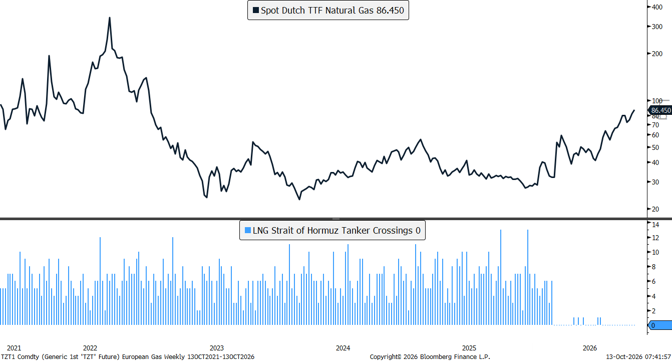
Outside of the crude oil market, a second energy crisis has emerged in liquefied natural gas (LNG). European gas prices, measured by the benchmark Dutch Title Transfer Facility (TTF) contract, have surged nearly 200% this year as global supplies tightened. Before the war, nearly 20% of global LNG supply moved through the Strait of Hormuz, leaving the market especially vulnerable to its closure.
Oil exporters have partially mitigated the disruption through bypass pipelines and ship-to-ship transfers, but LNG is much harder to reroute. Transferring LNG between vessels is operationally complex and relatively rare, while Qatar and the United Arab Emirates have limited alternatives for moving LNG exports out of the Persian Gulf. And while vessel-tracking data have shown some improvement in LNG traffic, flows remain well below prewar levels and the timing of a full recovery remains highly uncertain.
European Natural Gas Prices Soar as Middle Eastern Supply Remains Restricted
Source: LPL Research, Bloomberg 10/12/26Indexes are unmanaged and cannot be invested in directly. Past performance is no guarantee of future results. Any commodities, options or futures referenced are being presented as a proxy, not as a recommendation.
Structural Shift in Europe’s Supply Mix
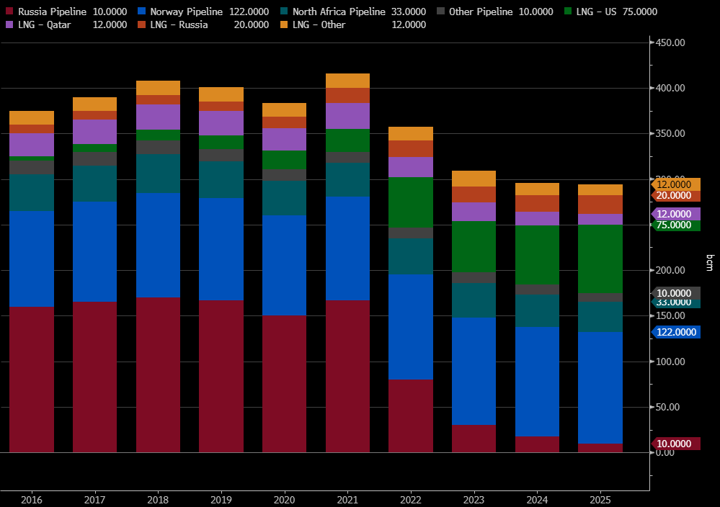
The latest supply shock follows a notable transformation in Europe’s natural gas supply chain. Before Russia’s invasion of Ukraine, Europe relied heavily on relatively inexpensive and predictable Russian pipeline gas. However, after the war broke out in 2022, Russia was hit with strict economic sanctions and as a result, they essentially weaponized their energy assets by restricting supply to Europe for political leverage. The European Union also adopted legislation last year to phase out their reliance on Russian gas by fourth quarter of 2027.
While this removed one geopolitical dependency, it also created another one. Much of the lost pipeline supply has been replaced by seaborne LNG, making Europe more exposed to global spot prices, shipping constraints, geopolitical chokepoints, and competition from Asian buyers. Pipeline gas represented roughly 52% of European imports in 2025, down from 76% in 2021, while LNG’s share nearly doubled from 24% to 48% over the same period.
European Gas Supply Mix by Source
Source: LPL Research, Bloomberg 10/12/26. Based on Bloomberg estimates using billion cubic meters (bcm). Indexes are unmanaged and cannot be invested in directly. Past performance is no guarantee of future results. Any commodities, options or futures referenced are being presented as a proxy, not as a recommendation.
Subdued Storage Levels Raise Winter Risk
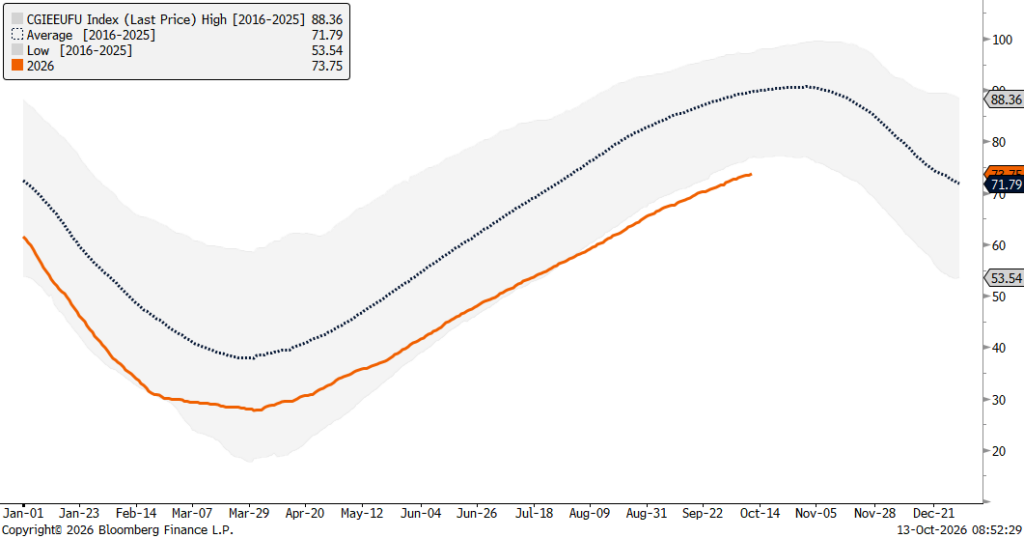
The combined impact from limited flows of LNG through the Strait of Hormuz and loss of Russian pipeline supply has become apparent in European storage levels. Europe is now entering the winter with gas supply running 20% below the seasonal average for this time of year. With withdrawal season right around the corner, a colder-than-expected winter in Europe could pull inventory levels to critically low levels, especially if LNG from Qatar and the United Arab Emirates remains trapped in the Persian Gulf.
Even a mild winter would not eliminate the risk of higher prices. Europe will likely still need to rebuild inventories from a depleted starting point ahead of the following heating season. That could sustain demand for LNG through the spring and summer, creating a higher floor under European gas prices and intensifying competition with Asian buyers.
European Gas Storage is Running Historically Low
Source: LPL Research, Bloomberg 10/12/26. Indexes are unmanaged and cannot be invested in directly. Past performance is no guarantee of future results. Any commodities, options or futures referenced are being presented as a proxy, not as a recommendation.
Conclusion:
Europe has diversified away from Russian pipeline gas, but it has not eliminated its external energy dependence. Instead, the region has exchanged its reliance on Russia for greater dependence on global LNG markets, introducing new risks tied to spot prices, shipping constraints, geopolitical chokepoints, and competition for supply.
The disruption to LNG exports through the Strait of Hormuz is exposing the vulnerabilities of their new supply model. Low storage levels, constrained Middle Eastern supply, and the approaching winter mean Europe is paying a premium to secure cargoes. A rebound in Chinese or broader Asian demand would intensify that competition, potentially pulling supply away from Europe and pushing prices higher.
The outlook for European natural gas prices remains skewed to the upside, with low inventories likely to keep prices elevated and volatile throughout the winter. Even if weather conditions are mild and LNG flows improve, the need to rebuild depleted inventories could establish a higher price floor into next year.
The immediate risk of physical shortages appears lower than during the 2021–2022 crisis because Europe has expanded its import infrastructure, reduced gas consumption, and become more reliant on U.S. LNG supply. The more significant threat is economic. Persistently high gas prices could raise household energy bills, erode purchasing power, pressure energy-intensive industries, weaken growth, and keep inflation above the European Central Bank’s (ECB) target. That combination could leave the ECB facing an uncomfortable higher-for-longer policy environment, further weighing on economic activity. Within equities, LPL Research continues to recommend overweighting the U.S. while maintaining a cautious outlook on Europe.
Important Disclosures
This material is for general information only and is not intended to provide specific advice or recommendations for any individual. There is no assurance that the views or strategies discussed are suitable for all investors. To determine which investment(s) may be appropriate for you, please consult your financial professional prior to investing.
Investing involves risks including possible loss of principal. No investment strategy or risk management technique can guarantee return or eliminate risk.
Indexes are unmanaged and cannot be invested into directly. Index performance is not indicative of the performance of any investment and does not reflect fees, expenses, or sales charges. All performance referenced is historical and is no guarantee of future results.
This material was prepared by LPL Financial, LLC. All information is believed to be from reliable sources; however LPL Financial makes no representation as to its completeness or accuracy.
Unless otherwise stated LPL Financial and the third party persons and firms mentioned are not affiliates of each other and make no representation with respect to each other. Any company names noted herein are for educational purposes only and not an indication of trading intent or a solicitation of their products or services.
Asset Class Disclosures –
International investing involves special risks such as currency fluctuation and political instability and may not be suitable for all investors. These risks are often heightened for investments in emerging markets.
Bonds are subject to market and interest rate risk if sold prior to maturity.
Municipal bonds are subject and market and interest rate risk and potentially capital gains tax if sold prior to maturity. Interest income may be subject to the alternative minimum tax. Municipal bonds are federally tax-free but other state and local taxes may apply.
Preferred stock dividends are paid at the discretion of the issuing company. Preferred stocks are subject to interest rate and credit risk. They may be subject to a call features.
Alternative investments may not be suitable for all investors and involve special risks such as leveraging the investment, potential adverse market forces, regulatory changes and potentially illiquidity. The strategies employed in the management of alternative investments may accelerate the velocity of potential losses.
Mortgage backed securities are subject to credit, default, prepayment, extension, market and interest rate risk.
High yield/junk bonds (grade BB or below) are below investment grade securities, and are subject to higher interest rate, credit, and liquidity risks than those graded BBB and above. They generally should be part of a diversified portfolio for sophisticated investors.
Precious metal investing involves greater fluctuation and potential for losses.
The fast price swings of commodities will result in significant volatility in an investor’s holdings.
This research material has been prepared by LPL Financial LLC.
Not Insured by FDIC/NCUA or Any Other Government Agency | Not Bank/Credit Union Deposits or Obligations | Not Bank/Credit Union Guaranteed | May Lose Value
For Public Use – Tracking: #1190739